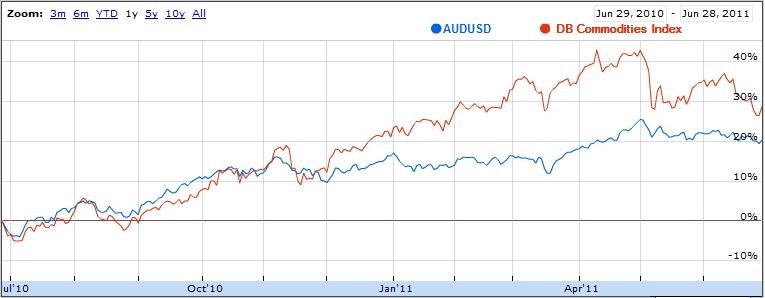
First of all, the putative economic boom that is taking place in Australia is being driven entirely by high commodity prices and surging production and exports. Since peaking at the end of April, commodity prices have fallen mightily. You can see from the chart above that there continues to exist a tight correlation between the AUD/USD and commodities prices. As commodities prices have fallen over the last two months, so has the Australian Dollar.
In addition, while demand will probably remain strong over the long-term, it may very well slacken over the short-term, due to declining economic growth across the industrialized world. Consider also that Australia’s largest market for commodity exports – China – may have difficulty sustaining a GDP growth rate of 10%, and at the very least, new fixed-asset investment (which necessitates demand for raw materials) will temporarily peak in the immediate future.
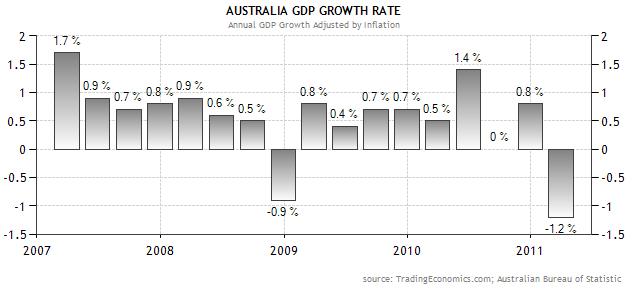
Mr. Parkinson’s optimistic forecasts might also be undermined in the short-term by a looser-than-expected monetary policy. The Reserve Bank of Australia last hiked its benchmark interest rate in November 2010, and may not hike again for a few more months due to moderating economic growth and proportionally moderate inflation. Given that an attractive interest rate differential may be driving some of the speculative activity that has girded the Aussie’s rise, a decline in this differential could likewise propel it downward.
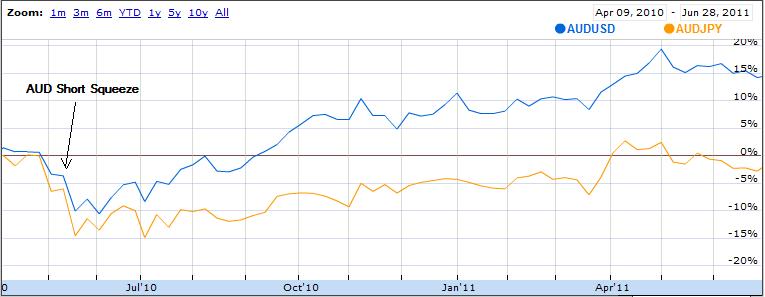
Ultimately, as one commentator recently pointed out, the Aussie’s 70% rise since 2008 might better be seen as US Dollar weakness (which also catalyzed the rise in commodity prices). The apparent stabilizing of the dollar, then, might let some air out of the currency down under.

Tidak ada komentar:
Posting Komentar